Squirrel and Pine
Marten Survey
27.01.26
THE All Ireland Squirrel
and Pine Marten Survey 2026 has been officially
launched. This initiative is an invitation to members of
the public to become citizen scientists and help track
some of our most iconic woodland mammals.
Led by researchers in University of Galway, Ulster
Wildlife and the Vincent Wildlife Trust, the survey aims
to map the latest distribution of red and grey
squirrels, and the pine marten across the island of
Ireland. |
 |
|
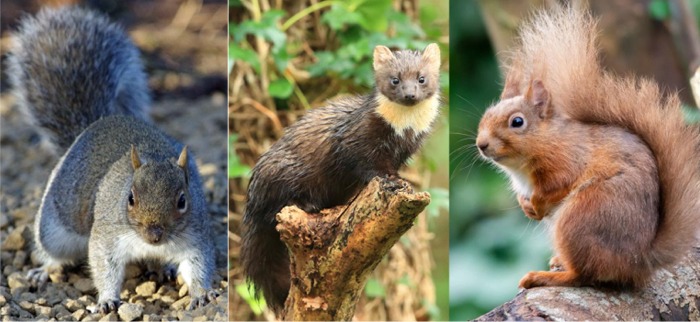
Pictured from left to
right: Grey Squirrel, photo by Gillian Day, Pine Marten,
photo by Ronald Surgenor and Red Squirrel, photo by Katy
Bell. |
Members of the public are
invited to record their sightings of the three species
throughout 2026, helping researchers build a detailed
picture of how their populations are changing.
Sightings of all three mammals can be recorded on the
online survey form at
www.biodiversityireland.ie .
The survey is part of a long-running monitoring
programme, with previous surveys carried out on four
occasions since 1997, providing vital insights into
long-term trends and conservation success.
The red squirrel is Ireland’s only native squirrel
species, once widespread in forests and wooded areas.
The introduction of the grey squirrel in 1911 has had
devastating consequences on our native species through
disease and competition for food, leading to the
disappearance of red squirrels from large parts of the
country.
For many years, the future of the red squirrel looked
bleak. However, recent surveys have revealed a
remarkable and unexpected turnaround, with the grey
squirrel being knocked back in certain areas, and the
reds showing signs of recovery. In several regions, grey
squirrel numbers have declined sharply, while red
squirrels are showing encouraging signs of recovery.
Research linked this shift to the successful comeback of
another native species, the pine marten - tree dwelling
carnivores and one of the few predators that can
successfully hunt grey squirrels. Because the red
squirrel evolved alongside pine martens, they are better
adapted to avoiding them and can escape danger more
easily. |
|


